
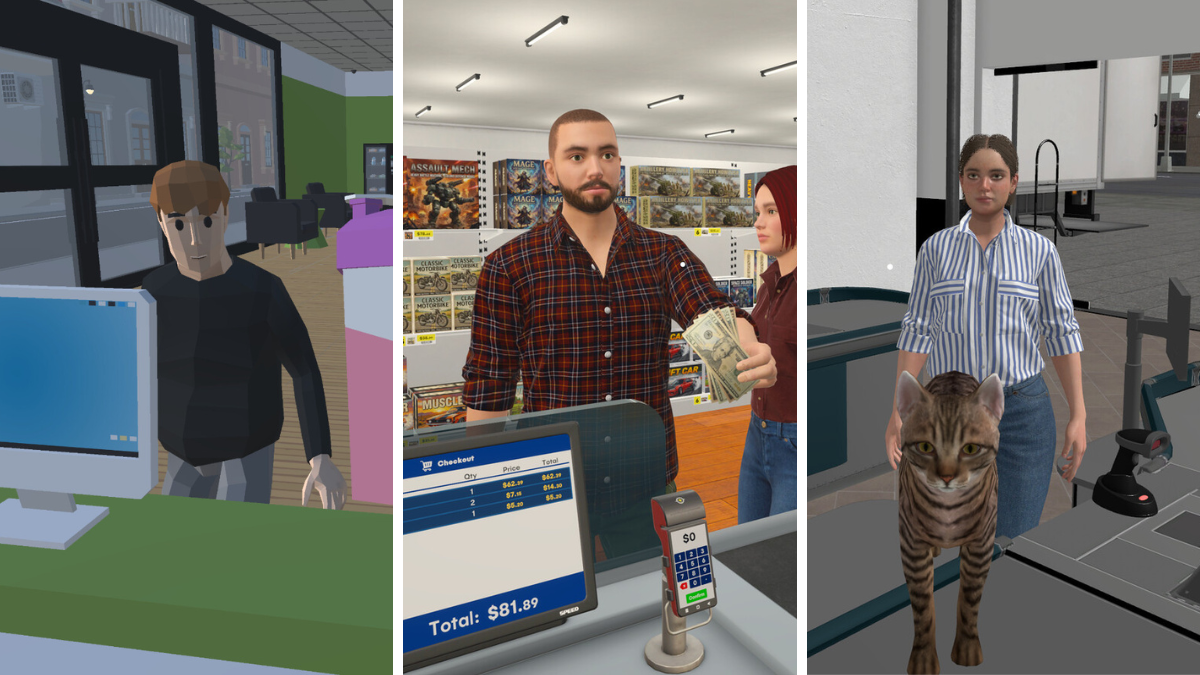
The relentless flood of retail simulators on Steam shows absolutely no signs of slowing down. What initially appeared to be a passing trend when it landed with torrential force in late 2024 has now become a permanent fixture of the platform’s weekly release schedule. The sheer volume of these games continues to astound industry observers, but perhaps even more surprising is how many of them manage to find an audience despite their often rudimentary appearance and repetitive gameplay loops. Last week alone, fourteen retail simulators were released on Steam, each vying for attention in an increasingly crowded marketplace that seems to defy conventional wisdom about market saturation.
To be clear about the classification here, we’re being quite selective about what constitutes a “retail sim.” Idle games with retail or service industry themes don’t make the cut. Horror games set in retail environments—and there are plenty of those, including this week’s notable release Shift at Midnight—are excluded from the count. Puzzle games with service industry settings, like Nothing To Declare, also fall outside the definition. What we’re specifically tracking are those unmistakably first-person retail simulators that ultra-prolific Polish publisher PlayWay seemed to spawn into existence and which have been copied relentlessly ever since. You almost certainly know the type: players unpack boxes, operate checkouts, purchase and receive stock, and manage their growing business empire one mundane task at a time.
The Numbers Behind Last Week’s Retail Sim Invasion
The performance metrics from last week’s retail simulator releases paint a fascinating picture of this peculiar market segment. Boba Cafe Simulator emerged as the overwhelming winner, achieving a peak of 7,523 concurrent players and accumulating over 754 “overwhelmingly positive” reviews. Bookshop Simulator, which transitioned from early access to full 1.0 release, reached 1,378 concurrent players and distinguished itself through a more stylized visual presentation and the notable absence of AI-generated capsule art—a refreshing rarity in this genre. Mall Together rounded out the trio of successful launches with 1,199 peak concurrent players, appealing to those who dream of constructing entire shopping complexes rather than managing single outlets.
The remaining entries showed considerably more modest results. Car Sales Simulator peaked at 354 players, while Kimbap Heaven Simulator managed 223. Model Kit Shop Simulator and Toll Plaza Simulator hovered around the 117-125 range. At the bottom of the list, games like Bobble Shop Simulator, Datacenter Simulator, Golf Superstore Simulator, Gym Rat Simulator, and Waterpump Simulator struggled to break into double digits for concurrent players. This stark disparity in performance raises important questions about what separates successful retail sims from the countless forgotten titles that barely register on player radars.
The PlayWay Production Machine and Industry Tactics
The industrial-scale production of retail simulators can be traced largely to PlayWay, a publisher whose approach to game development has become legendary—or notorious, depending on your perspective. According to SteamDB data, PlayWay currently has 474 products listed on Steam, with well over 100 of those yet to be released. The company’s catalog is littered with vague release windows: numerous “TBAs,” plenty of “Soons,” scattered Q1 2027 targets, and nebulous 2026 promises. Some announced titles seem unlikely to ever materialize, such as Train Mechanic Simulator 2025, which would need a hasty name change to maintain any semblance of timeliness.
Industry analyst Simon Carless, writing in his respected GameDiscoverCo newsletter, theorized back in 2021 that PlayWay’s strategy involves announcing numerous games but only following through on development if they accumulate sufficient wishlists. Since wishlist numbers aren’t publicly available, it’s difficult to predict which announced titles will actually see release. However, both Low-Budget Repairs and Car Mechanic Simulator 2026 appear among Steam’s most wishlisted games, suggesting strong chances of completion. PlayWay has officially announced that the former has surpassed one million wishlists, essentially guaranteeing its eventual release. According to Carless, “there is a centralized ideas machine at PlayWay and associated companies. It generates, vets and commissions a large amount of ideas for games, and then works with newer Polish game devs to put them into action.”
Beyond Shovelware: Finding Quality Amid the Flood
While the term “shovelware” naturally comes to mind when surveying this landscape, the reality is more nuanced than simple dismissal would suggest. PlayWay does release genuinely decent, effortful games including House Flipper 2, Mr Prepper, and the Thief Simulator series. The publisher is also far from alone in the rapidly-produced retail sim business. The mysterious “Business Tycoon” studio, responsible for Mall Together, Sporting Goods Shop, Tobacco Shop Simulator, and Retail Company Simulator, operates with similar prolificacy. Good luck finding any substantial information about this enigmatic developer—all of their games are published by the ultra-prolific Chinese company Gamersky Games, adding another layer of opacity to an already murky industry segment.
Fortunately, smaller studios are also carving out space in this genre without taking the scorched earth approach. Blood Pact Studios, creators of Retro Rewind – Video Store Simulator, and Caikemi, the team behind Boba Cafe Simulator, represent developers putting genuine love and effort into their creations. There is authentic demand for these experiences, and dedicated studios are meeting it with quality products. The pattern mirrors what has always been true in gaming: where high demand exists, a deluge of low-effort clones inevitably follows. The challenge for consumers lies in distinguishing the gems from the garbage—a task made increasingly difficult as the volume continues to rise.
This Week’s Steam Top Sellers and Notable Releases
Steam’s weekly revenue charts, released every Wednesday, showed some interesting movements. Counter-Strike 2 maintained its top position despite Palworld’s highly anticipated 1.0 launch pushing it to second place. Assassin’s Creed Black Flag Resynced‘s continued presence in third position surprised many observers, given that the original game has been available at deep discounts for over a decade. The remake represents a fairly conservative visual upgrade, but it serves as a reminder of the enduring popularity of the Assassin’s Creed franchise. The Steam Deck held fourth position, while Marvel Rivals, Apex Legends, and Warframe filled out the middle rankings.
Among the week’s deep cuts, several titles deserve attention. Offbeat offers a creative experience centered on collecting unusual instruments and composing music for clients with specific requirements, complete with an in-game DAW that allows exporting songs as WAV files. Atomcraft presents a building sandbox where every pixel is physically and chemically simulated, enabling players to experiment with 118 elements. Gurei delivers a boss rush action-platformer with dynamic difficulty scaling, featuring art that evokes both Hollow Knight and Cuphead. And Shift at Midnight, despite technically falling outside our retail sim definition as a horror game, has accumulated nearly 1,500 “overwhelmingly positive” reviews, proving that the retail setting continues to resonate with players across multiple genres.
Expert Opinion: The retail simulator phenomenon represents a fascinating case study in digital marketplace dynamics, where low production costs and high discoverability create sustainable business models even for games that attract only modest audiences. As long as development costs remain minimal and Steam’s algorithm continues to surface niche titles to interested players, we can expect this flood to continue well into 2026 and beyond. The real question isn’t whether retail sims will stop being made—it’s whether the genre will eventually produce a breakout hit significant enough to influence mainstream game design.